
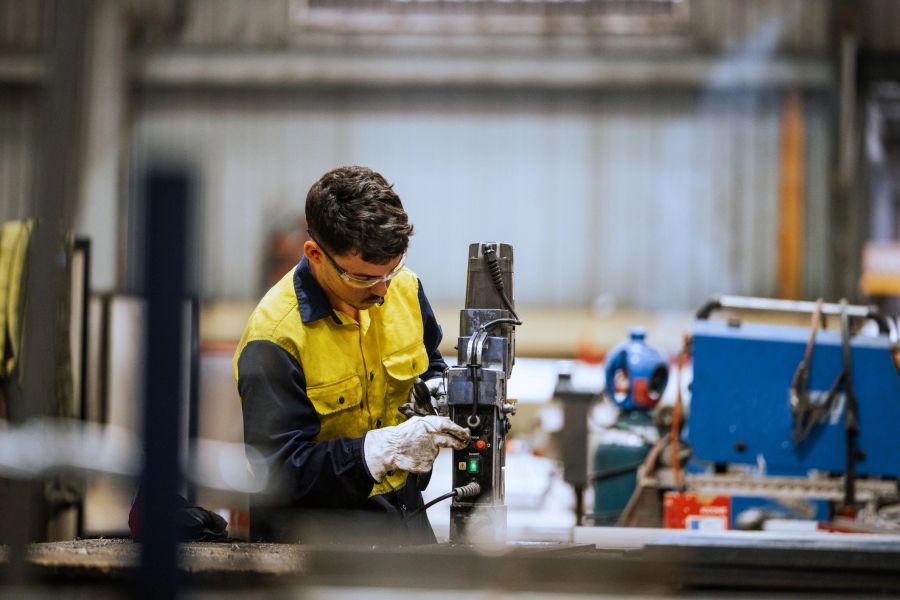
AI-Driven Predictive Maintenance in Australian Manufacturing: What Works
Predictive maintenance using AI is reducing unplanned downtime in Australian manufacturing facilities. Here is an honest assessment of where the technology delivers, what it requires, and how to get started.
Predictive maintenance is the application of AI in manufacturing that has attracted the most attention and investment — and for good reason. Unplanned equipment downtime is one of the most expensive problems in manufacturing, and AI-driven predictive maintenance offers a credible path to reducing it significantly.
But the gap between vendor promises and operational reality is significant. This article provides an honest assessment of where AI predictive maintenance delivers genuine value in Australian manufacturing, what it actually requires to work, and how maintenance engineers can approach implementation effectively.
What Predictive Maintenance Actually Is
Predictive maintenance uses sensor data and machine learning to identify patterns in equipment behaviour that precede failures. The goal is to detect developing faults early enough to plan and execute maintenance before the failure occurs — converting unplanned breakdowns into planned maintenance events.
This is distinct from:
- Reactive maintenance — fixing equipment after it fails
- Preventive maintenance — maintaining equipment on a fixed schedule regardless of condition
- Condition-based maintenance — monitoring equipment condition and maintaining when condition thresholds are exceeded
Predictive maintenance is the most sophisticated approach, using AI to identify subtle patterns in sensor data that indicate developing faults before they reach the threshold of obvious condition degradation.
The Sensor Foundation
AI predictive maintenance is only as good as the sensor data it receives. The most commonly used sensor types are:
Vibration sensors — the most widely used for rotating equipment. Vibration signatures change characteristically as bearings wear, gears develop faults, and imbalance develops. Vibration analysis can detect bearing faults weeks to months before failure.
Temperature sensors — useful for detecting overheating in motors, bearings, and electrical equipment. Infrared thermography can identify hot spots in electrical panels and mechanical equipment.
Current signature analysis — monitoring the electrical current drawn by motors can detect mechanical faults (bearing wear, misalignment) and electrical faults (winding degradation) without physical contact with the equipment.
Acoustic emission sensors — detect high-frequency stress waves generated by developing cracks, bearing defects, and other fault mechanisms. Useful for detecting faults that do not produce significant vibration.
Oil analysis — monitoring the condition of lubricating oil (particle count, viscosity, contamination) provides information about wear rates and contamination that other sensors cannot detect.
Where AI Adds Value Over Traditional Condition Monitoring
Traditional condition monitoring uses threshold-based alerts — when vibration exceeds a set level, an alert is triggered. This approach works but has limitations: it requires expert knowledge to set appropriate thresholds, it misses complex multi-parameter fault signatures, and it generates many false alarms.
AI predictive maintenance improves on this in several ways:
Multi-parameter analysis — AI can simultaneously analyse data from multiple sensors and identify complex patterns that involve interactions between parameters. A bearing fault might produce subtle changes in vibration, temperature, and current simultaneously, which an AI model can detect earlier than any single-parameter threshold.
Baseline learning — AI models learn the normal operating signature of each specific piece of equipment, accounting for normal variation due to load, speed, and environmental conditions. This reduces false alarms compared to fixed thresholds.
Fault classification — advanced AI models can not only detect that something is wrong but classify the likely fault type, helping maintenance engineers prioritise and plan the appropriate response.
Remaining useful life estimation — AI models can estimate how much time remains before a fault becomes a failure, enabling more precise maintenance planning.
Realistic Performance Expectations
Australian manufacturers using AI predictive maintenance report:
- Unplanned downtime reductions of 20–40% for equipment covered by the system
- Maintenance cost reductions of 10–25% through better planning and reduced emergency repair costs
- False alarm rates that vary significantly by implementation quality — poorly implemented systems can generate more false alarms than they prevent
These gains are most significant for:
- High-value, high-criticality equipment where failures are expensive
- Equipment with well-understood failure modes that produce detectable sensor signatures
- Facilities with good sensor infrastructure and data quality
The gains are less significant for:
- Equipment with infrequent, random failures that do not produce detectable precursors
- Facilities with poor sensor infrastructure or data quality
- Equipment where the cost of failure is low
Implementation Realities
The training period is real. AI predictive maintenance models need time to learn the normal operating signatures of your equipment. This typically takes 3–6 months of data collection before the model reaches reliable predictive accuracy. During this period, the system is learning, not predicting.
Data quality is the limiting factor. Sensor data that is noisy, inconsistent, or incomplete will produce unreliable predictions. Sensor calibration, data transmission reliability, and data storage quality all matter.
Integration with maintenance workflows is essential. A predictive maintenance alert that is not acted on promptly is worthless. The system needs to be integrated with your CMMS so that alerts automatically generate work orders and are tracked through to completion.
Maintenance engineering expertise remains essential. AI predictive maintenance systems generate alerts; maintenance engineers decide what to do about them. The system's value depends on the quality of the engineering response to its outputs.
A Practical Starting Point
For maintenance engineers considering AI predictive maintenance, a practical starting sequence:
- Select one high-value, high-criticality asset — ideally one with a known failure history and existing sensor infrastructure
- Audit the sensor data quality — is the data reliable, consistent, and complete?
- Establish a baseline — document current failure frequency and downtime costs
- Select a platform — IBM Maximo, Uptake, or Azure IoT depending on your scale and existing infrastructure
- Run a 6-month pilot — allow the model to learn before evaluating performance
- Measure and report — compare failure frequency and downtime against the baseline
The AMGC co-investment program can offset implementation costs for qualifying projects.
Stay informed
Get AI news every Friday
The AI Digest delivers the week's most important AI stories — free, in plain English.
Subscribe free →Related Articles
More Professions →
Robots on the Factory Floor: How AI Is Changing Australian Manufacturing Jobs
Cobots and AI quality inspection are on Australian factory floors. Some jobs are changing, others are being created. Here's what the evidence actually shows.

How AI Is Improving Production Scheduling in Australian Manufacturing
Production scheduling in Australian manufacturing is complex — high product mix, shared equipment, and frequent disruptions make manual scheduling slow and error-prone. AI scheduling tools are delivering measurable improvements in throughput and on-time delivery.
How AI Is Helping Australian Maintenance Engineers with Safety Compliance
Maintenance work in Australian manufacturing involves some of the highest safety risks in any industry. AI tools are reducing the documentation burden of safety compliance while improving the quality of safety management.