
Why Australia Must Expand Its Energy Grid to Stay in the AI Boom
Australia risks being left behind in the global AI race unless it dramatically expands its electricity grid. Here is why energy infrastructure is the foundation of the AI economy.
Australia is in a strong position to become a serious player in the global AI economy. It has a well-educated workforce, a stable legal system, world-class universities, and a growing technology sector. But there is one constraint that could undermine all of it: electricity.
The data centres, cloud computing infrastructure, and AI training clusters that power the modern AI economy are among the most energy-intensive facilities ever built. Without a grid that can reliably supply large volumes of clean, affordable electricity, Australia cannot attract the infrastructure investment that underpins AI leadership — and the window to act is narrowing.
How Much Power Does AI Actually Use?
The scale of AI's electricity demand is not widely understood outside the technology sector, and the numbers are striking.
A single query to a large language model such as GPT-4 consumes roughly ten times the electricity of a standard Google search, according to analysis published by the International Energy Agency (IEA) in its 2024 Electricity report. The IEA projected that global data centre electricity consumption could more than double between 2022 and 2026, rising from around 460 terawatt-hours to potentially over 1,000 terawatt-hours annually — roughly equivalent to Japan's entire electricity consumption.
Microsoft, Google, Amazon, and Meta have each announced multi-billion-dollar data centre expansion programmes globally. In Australia, Microsoft committed in March 2024 to invest A$5 billion in cloud and AI infrastructure over two years, and Amazon Web Services announced a A$20 billion investment in Australian cloud infrastructure through to 2029, paired with new renewable energy projects.
These are not hypothetical investments. They are happening now. The question is whether Australia's electricity grid can support the next wave — and the wave after that.
The Grid Australia Has vs. The Grid It Needs
Australia's National Electricity Market (NEM), which covers the eastern and south-eastern states, was designed in the 1990s for a very different energy landscape. It was built around large centralised coal-fired generators feeding power to residential and commercial users. The transition to renewables — solar, wind, and battery storage — is well underway, but the transmission infrastructure connecting generation to demand has not kept pace.
The Australian Energy Market Operator (AEMO) publishes an Integrated System Plan (ISP) that maps out what the grid needs to look like to support Australia's energy transition. The 2024 ISP identified approximately 10,000 kilometres of new and upgraded transmission lines as necessary by 2050, at an estimated cost of around A$73 billion in network investment. This is not gold-plating — it is the minimum required to connect renewable energy zones in regional areas to population centres where demand is concentrated.
The challenge for AI infrastructure is that data centres are not evenly distributed across the country. They cluster near major cities — Sydney, Melbourne, and increasingly Canberra — where fibre connectivity, skilled labour, and existing power infrastructure already exist. These are also the areas where grid congestion is most acute and where new large loads face the longest connection queues.
Why Renewable Energy and AI Are Natural Partners
There is a compelling alignment between Australia's renewable energy ambitions and the needs of the AI industry that is worth understanding clearly.
Hyperscale technology companies — the Microsofts, Googles, and Amazons of the world — have made binding public commitments to power their operations with 100 per cent renewable energy. This is not purely altruistic; it reflects investor pressure, regulatory trends in their home markets, and genuine corporate sustainability strategies. When these companies evaluate where to build data centres, the availability of credible, long-term renewable power purchase agreements (PPAs) is a significant factor.
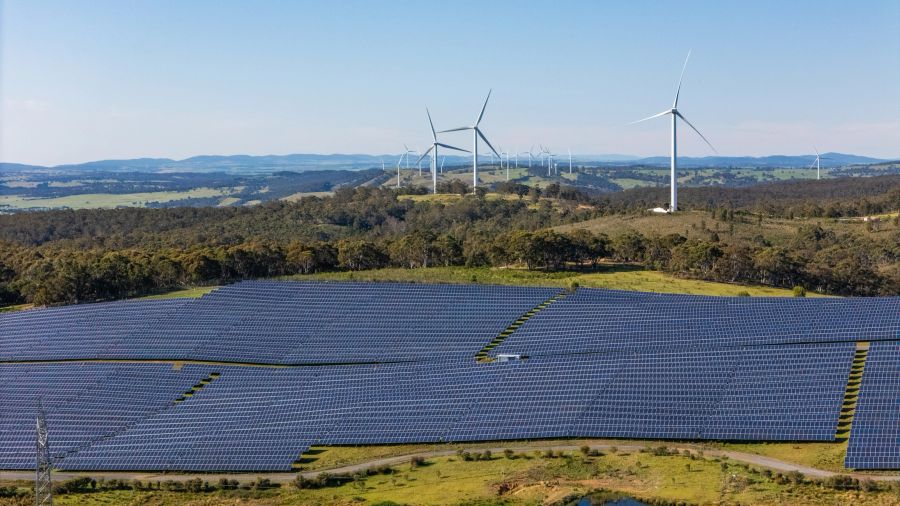
Australia has extraordinary renewable energy resources. The Clean Energy Council reported that Australia generated a record 39.4 per cent of its electricity from renewables in 2023, and the trajectory is strongly upward. The Australian Renewable Energy Agency (ARENA) and the Clean Energy Finance Corporation (CEFC) have collectively deployed billions of dollars into solar, wind, and storage projects. The Snowy 2.0 pumped hydro project, when complete, will add 2,000 megawatts of dispatchable storage capacity to the NEM.
For AI companies, Australia's renewable energy pipeline is genuinely attractive — but only if the grid can deliver that energy reliably to the locations where data centres want to be built. A solar farm in western New South Wales is of limited value to a data centre in western Sydney if the transmission line connecting them does not exist or is already congested.
The Economic Case: What Is at Stake
The economic opportunity from AI infrastructure investment is substantial and well-documented.
CSIRO has estimated that digital technologies, including AI, could contribute up to A$315 billion to Australia's GDP by 2030. A significant portion of that value depends on Australia being a credible location for AI infrastructure — not just a consumer of AI services built elsewhere.
Data centres are high-value economic assets. They create direct employment in construction, operations, and technical roles. They attract ancillary investment in fibre, cooling, and security services. They generate significant tax revenue. And critically, they anchor the digital supply chains that Australian businesses — from banks to hospitals to logistics companies — depend on.
The Albanese Government's National Reconstruction Fund and the Future Made in Australia agenda both identified digital infrastructure as a priority sector. The 2024-25 Federal Budget included substantial investment in digital infrastructure and sovereign AI capability under the Future Made in Australia agenda. State governments have also moved: the New South Wales Government released a Data Centre Strategy in 2023 identifying energy supply as a critical enabler of data centre growth in the state.
If Australia cannot supply the energy these facilities need, the investment will go elsewhere — to Singapore, Japan, the United States, or the United Arab Emirates, all of which are actively competing for exactly this infrastructure.
The Transmission Bottleneck
The most immediate constraint is not generation — Australia is building renewable energy at pace — but transmission.
New large electricity consumers, including data centres, must connect to the grid through a regulated process managed by network service providers. In practice, this means navigating connection queues that can stretch for years, paying significant upfront connection costs, and accepting curtailment risk when the local network is congested.
AEMO's 2024 ISP identified several priority transmission projects that would directly benefit data centre development in New South Wales and Victoria, including the HumeLink project (connecting Snowy 2.0 to the Sydney and Canberra regions) and the VNI West project (a new interconnector between Victoria and New South Wales). Both projects have faced delays related to planning approvals, community consultation, and land access — challenges that are not unique to Australia but that require active government engagement to resolve.
The good news is that the policy framework is moving in the right direction. The Rewiring the Nation programme, announced by the Albanese Government in 2022, committed A$20 billion to accelerate transmission investment through the NEM. The Australian Energy Infrastructure Commissioner has been working to streamline community consultation processes for transmission projects. And several state governments have established dedicated renewable energy zones with pre-approved transmission corridors to reduce connection uncertainty for new generators and large loads.
The scale of this challenge is already visible in New South Wales. The NSW Government has acknowledged that planned data-centre investment will create a major new source of electricity demand, requiring additional electricity infrastructure. It is actively considering reforms to allow data centres to connect to the grid without imposing additional costs and risks on households and small businesses. That policy debate — about who pays for the additional grid capacity required by large new loads — is going to become one of the defining infrastructure questions of the next decade.
What Expanded Grid Infrastructure Actually Delivers
It is worth being specific about what a more capable electricity grid enables for Australia's AI economy, because the benefits extend well beyond the data centre sector.
Sovereign AI capability. Australia's ability to train, fine-tune, and run AI models on Australian infrastructure — rather than relying entirely on overseas cloud providers — depends on having the energy to power that infrastructure. This matters for national security, data sovereignty, and the ability of Australian researchers and businesses to work with sensitive data under Australian law.
Lower operating costs for AI businesses. Electricity is consistently one of the largest operating costs for a data centre. Australia's renewable energy resources, if properly connected to demand, offer the prospect of competitive long-run electricity costs compared to markets that rely more heavily on gas or imported fuels. This cost competitiveness is a genuine differentiator for attracting AI investment.
Regional economic development. Many of Australia's best renewable energy resources are in regional areas — the New England tablelands, the Riverina, the Pilbara, the South Australian outback. Connecting these resources to the grid creates economic activity in communities that have historically depended on agriculture or extractive industries. The construction and operation of transmission infrastructure, renewable energy projects, and associated facilities generates jobs and income in regions that need diversification.
Climate and energy security. A grid that can support large renewable energy loads is also a more resilient grid. The diversification of generation sources, combined with storage and demand flexibility, reduces Australia's exposure to fuel price shocks and supply disruptions. The AI sector's appetite for reliable, clean power is actually aligned with the broader energy transition — both require the same infrastructure investments.
The Path Forward
The case for expanding Australia's electricity grid is not primarily about accommodating AI data centres. It is about building the infrastructure that a modern, decarbonising economy needs. AI infrastructure investment is one of the most compelling near-term economic arguments for accelerating that work.
Several things need to happen in parallel.
Planning and approvals processes for transmission infrastructure need to be faster without sacrificing genuine community engagement. The current timelines — which can see major transmission projects take a decade from announcement to energisation — are not compatible with the pace at which AI infrastructure investment decisions are being made globally.
The regulatory framework for large electricity consumers, including data centres, needs to provide more certainty about connection costs and timelines. Investors making billion-dollar commitments need to know that the energy supply underpinning those investments is reliable and affordable over a 20-year horizon.
State and federal governments need to continue coordinating on renewable energy zones, transmission corridors, and the planning frameworks that govern where large infrastructure can be built. The National Energy Transformation Partnership, agreed between the Commonwealth and state and territory governments in 2022, provides a useful framework for this coordination.
And Australia needs to make the case internationally that it is a credible, stable, and energy-secure location for AI infrastructure investment. The country's political stability, rule of law, and proximity to Asian markets are genuine advantages — but they need to be backed by the physical infrastructure to deliver on the promise.
Australia's Moment
The global AI infrastructure buildout is one of the largest capital investment cycles in the history of the technology industry. Australia is well-positioned to capture a meaningful share of it — but only if the electricity grid can support the load.
The investments being made now in transmission, renewable energy, and storage are not just about meeting today's demand. They are about ensuring that when the next wave of AI infrastructure investment decisions is made — in boardrooms in Seattle, London, Tokyo, and Singapore — Australia is on the shortlist.
The grid is not a constraint to be managed. It is an opportunity to be seized.
Stay informed
Get AI news every Friday
The AI Digest delivers the week's most important AI stories — free, in plain English.
Subscribe free →Related Articles
More AI in Australia →
Nvidia Is Expanding Its AI Infrastructure Footprint in Australia
Nvidia is bringing next-generation GPU infrastructure to Australia — big implications for AI startups, researchers, and enterprises needing local compute.

Amazon Web Services Is Building Australia's AI Future From the Ground Up
AWS has committed billions to Australian AI infrastructure. The ripple effects are reaching startups, researchers, and enterprises. Here's what it means.
The Australian Suburbs Powering the Nation's AI Future
From Sydney's Tech Central to Melbourne's Fishermans Bend and Brisbane's Fortitude Valley, a growing network of innovation precincts across Australia is building the infrastructure, talent, and investment base for an AI-powered economy.