
AI for Horticultural Irrigation Management in Australia (2026)
How Australian horticulturists are using AI-assisted irrigation scheduling, soil moisture monitoring, and precision water management to improve crop quality and reduce water use.
AI-Assisted Irrigation Management in Australian Horticulture
Water is a critical and often constrained resource in Australian horticulture. Irrigation management decisions — when to irrigate, how much to apply, and how to distribute water across the growing area — directly affect crop quality, yield, and production costs. AI-assisted tools are helping Australian horticulturists make these decisions more precisely and efficiently.
Soil Moisture Monitoring
Soil moisture monitoring provides real-time data on the water status of the root zone, allowing growers to schedule irrigation based on actual crop water use rather than calendar-based rules or estimates. AI tools can analyse soil moisture data in combination with weather forecasts and crop growth stage information to generate irrigation scheduling recommendations.
Capacitance-based soil moisture sensors, such as those manufactured by Sentek Technologies (an Australian company), measure soil moisture at multiple depths in the root zone. This data can be accessed remotely via smartphone or computer, allowing growers to monitor soil moisture and make irrigation decisions without being physically present at the site.
Tensiometers measure soil water tension — the force required for plant roots to extract water from the soil — and provide a direct measure of plant-available water. They are widely used in Australian horticulture, particularly in vegetable production, as a simple and cost-effective irrigation scheduling tool.
Evapotranspiration-Based Scheduling
Evapotranspiration (ET) is the combined water loss from soil evaporation and plant transpiration. ET-based irrigation scheduling uses weather data to estimate daily crop water use and schedule irrigation to replace the water lost. AI tools can automate this calculation and integrate it with soil moisture data to provide more accurate scheduling recommendations.
The Bureau of Meteorology provides ET data for Australian weather stations through its SILO database. State agricultural departments and irrigation authorities provide ET-based irrigation scheduling tools and resources for Australian horticultural industries.
Precision Irrigation and Variable Rate Application
Precision irrigation systems can apply different amounts of water to different zones within a growing area based on soil variability, crop water use, and other factors. AI tools can analyse soil mapping data, crop monitoring data, and weather information to generate variable rate irrigation recommendations.
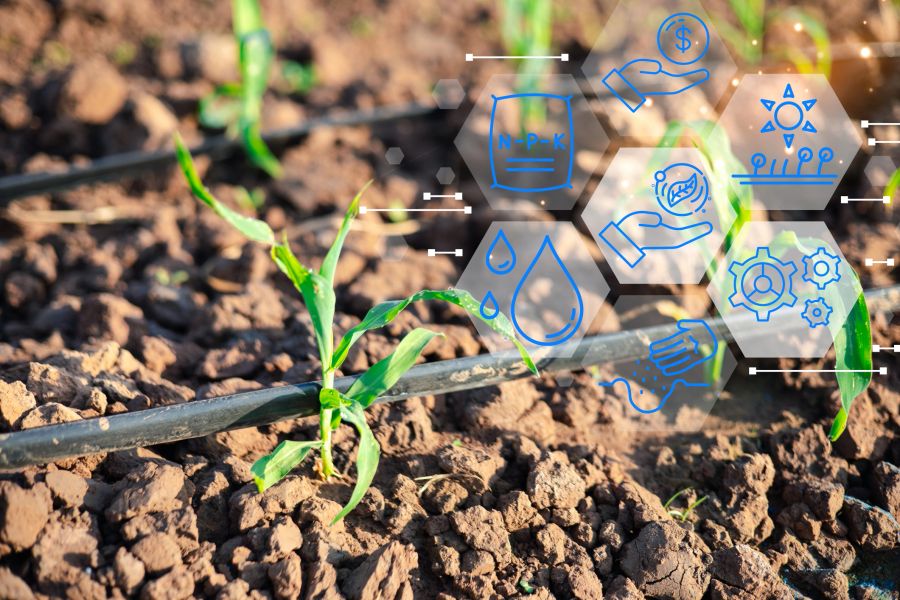
Drip irrigation systems, which deliver water directly to the root zone of individual plants, are widely used in Australian horticulture for their water use efficiency and ability to apply water and nutrients precisely. AI-assisted control systems can automate drip irrigation scheduling based on soil moisture sensor data and ET calculations.
Deficit Irrigation Strategies
Regulated deficit irrigation (RDI) and partial rootzone drying (PRD) are irrigation strategies that deliberately apply less water than the crop's full requirement during specific growth stages to improve fruit quality or reduce vegetative growth. These strategies are used in Australian viticulture, stone fruit, and some vegetable industries.
AI tools can assist with implementing deficit irrigation strategies by monitoring vine or plant water status and adjusting irrigation to maintain the target level of water deficit. The relationship between water deficit and fruit quality is well-documented in Australian horticultural research, and AI tools can help growers apply this knowledge more precisely.
Water Allocation and Compliance
Australian horticulturists operate under water allocation systems administered by state governments and irrigation authorities. AI tools can assist with tracking water use against allocation, forecasting water requirements for the season, and identifying opportunities to improve water use efficiency.
Water metering and reporting requirements vary by state and irrigation district. Farm management platforms that integrate water use records with irrigation scheduling data can simplify compliance reporting and help growers manage their water allocation effectively.
Stay informed
Get AI news every Friday
The AI Digest delivers the week's most important AI stories — free, in plain English.
Subscribe free →Related Articles
More Agriculture →
AI for Horticultural Pest and Disease Management in Australia (2026)
How Australian horticulturists are using AI tools for pest and disease identification, disease risk modelling, and integrated pest management to protect crops and reduce chemical use.
Best AI Tools for Horticulturists in Australia (2026)
The best AI tools for Australian horticulturists in 2026 — crop monitoring platforms, pest identification apps, irrigation management systems, grading technology, and farm business software.
AI for Horticulturists in Australia: The Complete Guide (2026)
A practical guide for Australian horticulturists on using AI to improve crop monitoring, pest and disease management, irrigation scheduling, market access, and horticultural business operations.