
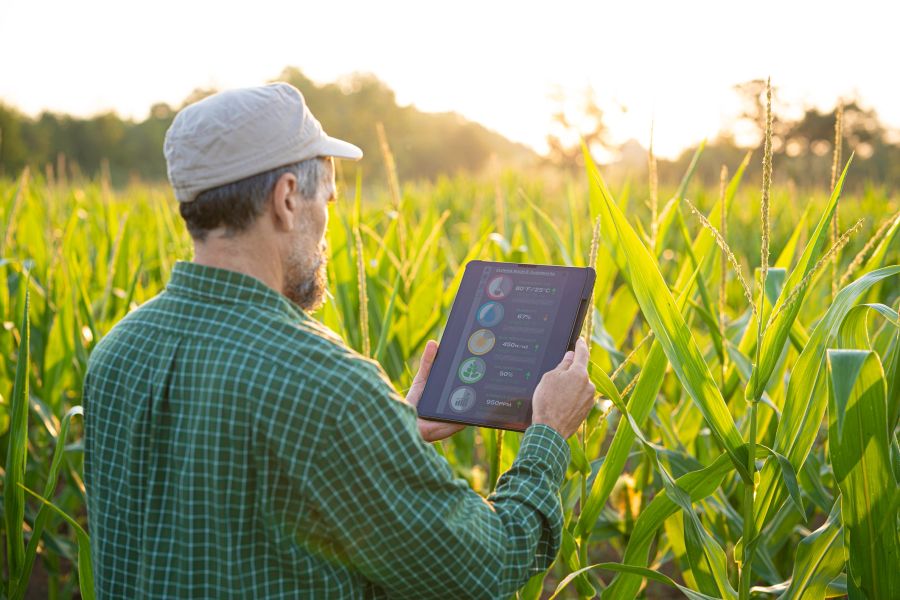
AI for Precision Farming in Australia: A Practical Guide (2026)
How Australian cropping farmers can use AI-powered precision farming tools to reduce input costs, improve yields, and manage paddock variability more effectively in 2026.
Precision farming is one of the most significant shifts in Australian cropping over the past decade, and AI is accelerating it. The core idea is straightforward: rather than treating every part of a paddock the same way, precision farming uses data to identify variability and respond to it — applying more where more is needed, and less where it isn't.
This guide explains how AI-powered precision farming tools work in practice, what Australian farmers are using them for, and how to evaluate whether they make sense for your operation.
The Foundation: Understanding Paddock Variability
Every paddock has variability — in soil type, nutrient levels, water-holding capacity, and historical yield performance. Traditional farming approaches manage to the average, which means over-applying inputs in some zones and under-applying in others.
AI-powered precision farming starts by mapping that variability. Satellite imagery platforms analyse vegetation indices — measures of plant health and biomass derived from multispectral imagery — to create detailed maps of how different parts of a paddock are performing at any given time. These maps are updated regularly throughout the season, giving farmers and agronomists a dynamic picture of crop development.
Soil sampling combined with AI analysis adds another layer, mapping nutrient levels, pH, and organic matter across a paddock to identify zones that need different management.
Variable Rate Application
Once paddock variability is mapped, variable rate application (VRA) technology allows machinery to apply inputs — fertiliser, lime, seed, herbicide — at different rates across a paddock in a single pass. The machinery reads a prescription map generated from the variability data and adjusts application rates automatically.
For fertiliser, this means applying more to high-potential zones that can convert inputs into yield, and less to low-potential zones where additional inputs won't produce a return. Research from the Grains Research and Development Corporation has found that variable rate fertiliser application can reduce input costs while maintaining or improving overall paddock yield, particularly in paddocks with significant variability.
For seeding, variable rate technology allows farmers to increase seeding rates in high-potential zones and reduce them in areas where establishment is typically poor — improving overall crop establishment without increasing total seed costs.
Satellite Crop Monitoring in Practice
Satellite crop monitoring platforms like Agworld, Cropx, and Trimble's Farmer Core provide regular imagery updates throughout the growing season. Farmers and agronomists can view paddock health maps, compare current performance against previous seasons, and identify areas that warrant closer inspection.
The AI component of these platforms goes beyond displaying imagery — it analyses patterns over time, flags anomalies that may indicate pest pressure, disease, or nutrient deficiency, and in some cases generates automated alerts when a paddock's vegetation index drops below a threshold.
For large cropping operations managing thousands of hectares, satellite monitoring makes it practical to maintain awareness of crop performance across the entire farm without physically inspecting every paddock every week.
Drone-Based Scouting
Drones equipped with multispectral cameras provide higher-resolution imagery than satellites, making them useful for detailed investigation of specific paddock areas. When satellite imagery flags a zone of concern, a drone flight can provide the detail needed to identify the cause — whether it's a pest, disease, waterlogging, or a mechanical issue with the seeder.
AI image analysis software can process drone imagery and automatically identify and map pest populations, disease lesions, or weed patches, providing a quantified assessment of the problem rather than a subjective visual estimate.
Yield Mapping and Analysis
Yield monitors on headers record yield data at every point across a paddock during harvest, creating detailed yield maps that show exactly where the crop performed well and where it didn't. Over multiple seasons, these maps reveal consistent patterns of high and low performance that can guide management decisions.
AI analysis of multi-year yield maps, combined with soil data and seasonal weather records, can identify the factors that most strongly influence yield variability on a specific property — providing a data-driven basis for management decisions rather than relying on intuition alone.
The Economics of Precision Farming
The business case for precision farming depends on the scale of the operation, the degree of paddock variability, and the cost of inputs. For large cropping operations with significant variability, the input savings from variable rate application can offset the cost of the technology relatively quickly.
For smaller operations, the economics are less clear-cut, and it's worth carefully evaluating which specific tools offer the best return for your situation. Starting with satellite crop monitoring — which has a relatively low cost and provides immediate value in terms of crop awareness — is often a practical first step before investing in variable rate application hardware.
Working with an Agronomist
Precision farming tools generate a lot of data, and getting value from that data requires agronomic interpretation. The most effective precision farming programs combine AI-powered data collection and analysis with the expertise of an agronomist who understands local conditions and can translate data insights into practical management decisions.
Many agronomists in Australia now work with precision farming platforms as a standard part of their service, and some offer data interpretation as a specific service. If you're considering adopting precision farming tools, discussing the approach with your agronomist early in the process will help ensure the data you collect is actually used to improve decisions.
Stay informed
Get AI news every Friday
The AI Digest delivers the week's most important AI stories — free, in plain English.
Subscribe free →Related Articles
More Professions →
AI for Freelancers in Australia: A Practical Guide (2026)
How Australian freelancers are using AI to win more clients, deliver better work, and run leaner businesses — without losing the personal quality that makes freelance work worth hiring.

AI for Clinical Documentation in Australia: A Practical Guide (2026)
How Australian doctors can use AI scribes and documentation tools to reduce note-writing time, improve record quality, and spend more time with patients in 2026.
How AI Is Transforming Australian Farming
AI drones, smart irrigation, and livestock sensors are transforming Australian farms — boosting yields, cutting costs, and helping farmers use less water.