
What Australia's AI Data Centre Boom Really Means for the Country
Billions of dollars in AI data centre investment are flowing into Australia — and the effects go well beyond server racks. From new jobs and cleaner energy grids to faster internet and a stronger sovereign tech capability, here is what the build-out actually means.
What Australia's AI Data Centre Boom Really Means for the Country
Australia is in the middle of a significant infrastructure moment. Over the past two years, some of the world's largest technology companies have announced or begun constructing major data centre facilities across the country — investments measured in the billions of dollars that are reshaping how Australia connects to the global digital economy.
This is not simply a story about server rooms. The data centre build-out touches energy infrastructure, employment, sovereign capability, regional development, and Australia's long-term position in the Asia-Pacific technology landscape. Here is what it actually means.
The Scale of What Is Being Built
The numbers are substantial. Microsoft announced a AU$5 billion investment in Australian data centre infrastructure in October 2023, covering an expansion from 20 to 29 sites over two years. In April 2026, Microsoft announced a further AU$25 billion investment by the end of 2029, covering AI infrastructure, computing capacity, security, and skills — making it one of the largest technology infrastructure commitments ever made in Australia. Google has committed to expanding its Australian cloud regions, with its primary Australian region based in Sydney. Amazon Web Services has operated Australian infrastructure since 2012 and has continued to expand its local footprint as demand grows. In 2025, AWS announced a AU$20 billion investment in Australian cloud computing and AI infrastructure planned for the period 2025 to 2029 — one of the largest single technology infrastructure commitments ever made in the country.
Alongside the hyperscalers, specialist AI infrastructure providers and colocation operators have also been expanding. Facilities in Western Sydney, Melbourne's outer suburbs, and increasingly in regional corridors are being built or upgraded to handle the computational demands of modern AI workloads.
The common thread across all of these investments is the same: the global demand for AI compute is growing faster than existing infrastructure can support, and Australia — with its stable regulatory environment, skilled workforce, and strategic location in the Asia-Pacific — is an attractive place to build.
What This Means for Jobs
Data centres create employment at multiple levels, and the effect is broader than the facilities themselves.
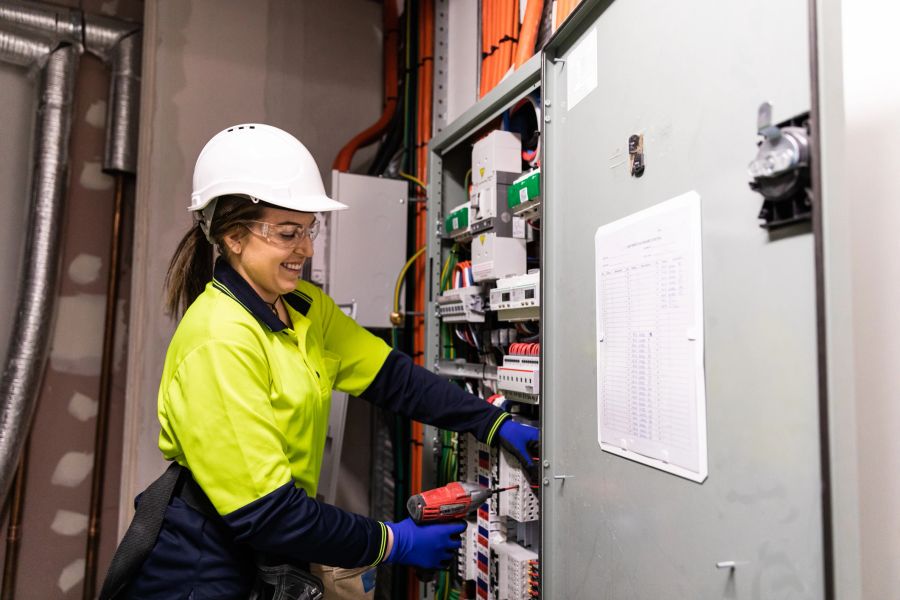
Construction and trades. Large-scale data centre construction is a significant employer of skilled tradespeople. Electricians, HVAC technicians, structural engineers, project managers, and civil contractors are all required in large numbers during the build phase. A single hyperscale facility can employ hundreds of construction workers over a multi-year build.
Ongoing operations. Once operational, data centres employ facility managers, network engineers, security personnel, and technical support staff. These are typically well-paid, stable roles that do not disappear once construction is complete.
Downstream technology roles. The presence of major cloud and AI infrastructure in Australia makes it easier for local businesses to build and deploy AI-powered products and services. This creates demand for software engineers, data scientists, machine learning engineers, and product managers — roles that are increasingly well-compensated and in high demand.
Indirect employment. The supply chains that support data centre operations — from cooling equipment to fibre cabling to security services — generate employment across a wide range of industries. Data centre investment is widely recognised by economists and industry analysts as having a significant multiplier effect on local economies, with construction, operations, and supply chain activity all contributing beyond the direct investment figure.
The Energy Infrastructure Opportunity
AI data centres are large consumers of electricity, and this is driving investment in energy infrastructure that benefits the broader grid.
Several major operators have made public commitments to powering their Australian facilities with renewable energy. Microsoft's Australian investments are aligned with its global commitment to be carbon negative by 2030. Google has long-term power purchase agreements with renewable energy generators in Australia. These commitments are accelerating investment in solar and wind generation capacity, as well as the grid infrastructure needed to connect new generation to load centres.
There is also a practical benefit for the grid. Some data-centre workloads can provide demand flexibility through workload shifting, batteries, on-site generation and other technologies, although the degree of flexibility varies considerably by facility and workload. New South Wales' 2026 data centre framework reportedly requires new facilities to demonstrate the ability to reduce grid electricity use by 25% during peak periods, using mechanisms such as load shifting, on-site generation or storage — reflecting the potential for flexibility while acknowledging it is not automatic or universal.
The investment in power infrastructure required to support data centres — new substations, transmission upgrades, and grid connections — also benefits other industrial and residential users in the same corridors.
Sovereign Capability and Data Residency
One of the less-discussed but genuinely important aspects of the data centre build-out is what it means for Australian data sovereignty.
When Australian government agencies, healthcare providers, financial institutions, and businesses store and process data in Australian-based facilities, that data is subject to Australian law. It is accessible to Australian courts and regulators. It is not subject to the extraterritorial reach of foreign legislation in the same way that data stored offshore might be.
The Australian Government has been progressively tightening requirements around data residency for sensitive government data, and the expansion of local cloud infrastructure makes compliance with these requirements more practical and cost-effective. The Critical Infrastructure Act 2018 and subsequent amendments have also elevated the importance of understanding where data is held and processed.
For sectors like healthcare, defence, and financial services, the availability of high-quality, locally-based AI infrastructure is not just a convenience — it is increasingly a compliance requirement and a risk management consideration.
Regional Development and Connectivity
While the largest facilities are concentrated in Sydney and Melbourne, the data centre build-out is also creating opportunities in regional Australia.
Renewable energy availability, land costs, and water access (for cooling) are all factors that make some regional locations attractive for data centre development. Locations outside the major metropolitan centres — particularly those with access to renewable energy, available land, and water for cooling — are being actively explored by operators looking to expand capacity, with the potential to bring construction activity and employment to regional communities.
The fibre optic networks that connect data centres to users also benefit regional connectivity. Investment in backbone infrastructure to support data centre operations has historically contributed to improved internet access and reduced latency for regional businesses and households along the same corridors.
Australia's Position in the Asia-Pacific
Australia's time zone, legal system, language, and political stability make it a natural hub for technology infrastructure serving the Asia-Pacific region. As AI adoption accelerates across Southeast Asia, Japan, South Korea, and the Pacific Islands, Australian-based infrastructure is well-positioned to serve regional demand with lower latency than facilities based in Europe or North America.
This geographic advantage is not lost on the major technology companies. Microsoft's investment announcements have explicitly referenced Australia's role as a hub for the Asia-Pacific region. The presence of major hyperscale infrastructure in Australia also makes the country more attractive to international technology companies looking to establish or expand their Asia-Pacific operations — creating a positive feedback loop of investment and capability.
What Comes Next
The current wave of data centre investment is likely to continue. The computational demands of AI are growing rapidly, and the infrastructure required to support them needs to be built ahead of demand rather than in response to it.
For Australia, the opportunity is to ensure that the benefits of this investment are broadly distributed — through skills development programs that prepare Australians for the jobs being created, through energy policy that captures the grid benefits of large-scale renewable-powered loads, and through regulatory frameworks that protect data sovereignty while remaining attractive to international investment.
The data centre build-out is, at its core, a vote of confidence in Australia as a place to invest, build, and operate critical technology infrastructure. The challenge and the opportunity for Australia is to make the most of it.
Stay informed
Get AI news every Friday
The AI Digest delivers the week's most important AI stories — free, in plain English.
Subscribe free →Related Articles
More Technology →
Nvidia Is Expanding Its AI Infrastructure Footprint in Australia
Nvidia is bringing next-generation GPU infrastructure to Australia — big implications for AI startups, researchers, and enterprises needing local compute.

Amazon Web Services Is Building Australia's AI Future From the Ground Up
AWS has committed billions to Australian AI infrastructure. The ripple effects are reaching startups, researchers, and enterprises. Here's what it means.

Why Australia Cannot Afford to Sit Out the AI Investment Race
As global technology companies restructure their entire revenue models around AI, Australian businesses face a defining choice: invest now and shape the future, or fall behind in the most consequential economic shift of the century.